Psychotherapy Studio

Don't just read about psychotherapy. Practice it.

Knowing why an approach works is not the same as knowing what to say at 2:40 on a Tuesday. Psychotherapy Studio is a place for psychiatric prescribers to get better at the therapeutic part of the work, without having to already be good at it.

Included with Full membership at Think Beyond Practice.

Understanding an approach and performing it are different skills.

Most of us trained hardest on the first one. We can explain why thought suppression does not work. Then the patient in front of us asks what to do about the thoughts, and the sentence that arrives is not the one we would write down.

That is not a lack of interest. Therapists build therapeutic skill through supervised practice, case consultation and repetition. As prescribers, our opportunities for that kind of psychotherapy-specific practice are a lot more variable. Mostly what is missing is somewhere safe to be bad at something first.

Start from the patient, not from the modality.

You rarely walk into a visit thinking "today I will use ACT". You think "my patient keeps avoiding things, and I want to work with that".

Find it

Start with the problem

Begin from what the patient is bringing, or from an approach you want to get better at.

Understand it

See why it fits

What the approach is targeting, and what it is trying to change.

Hear it

What it sounds like

Reviewed wording for what an intervention actually sounds like out loud.

Try it

Choose a response

Pick what you would say next, then read what that choice is doing clinically.

Name it

Recognize the work

Identify the therapeutic work you actually performed, and what it does not establish.

Document it

Write it honestly

Language that describes what happened without overstating it, and how it codes.

Reviewed clinical content, not a phrase bank.

Every modality record is clinician reviewed. Where the evidence behind a technique is narrower than the technique's reputation, the record says so rather than rounding up.

11
psychotherapy modalities
80
specific interventions
31
clinical focuses

Supportive, insight-oriented, motivational interviewing, CBT-informed, behavioral activation, solution-focused, problem-solving, interpersonal, mindfulness-informed, DBT-informed and ACT-informed work, each written for what a prescriber can realistically do inside a medication visit.

What a brief intervention is, and is not.

Using a technique informed by CBT, ACT, DBT or MI inside a medication visit is not the same as delivering a course of that psychotherapy. Some interventions can be done well in a few minutes. Others need structure, sequencing and follow-up that a brief visit cannot give them, and the Studio says which are which.

It also will not tell you that every brief technique earns a psychotherapy add-on code. What you did and what you may bill for are separate questions, and the Studio keeps them separate.

You practice, and the Studio tells you what your choice is doing.

A patient says something. You choose what you would say next. Then the Studio explains what that response is actually doing clinically, including when a perfectly reasonable answer is not the intervention you were reaching for.

There is no score and nothing is marked wrong. Two reasonable clinical responses can both be legitimate work while only one of them is the technique you were practicing, and saying that plainly teaches more than a tick would.
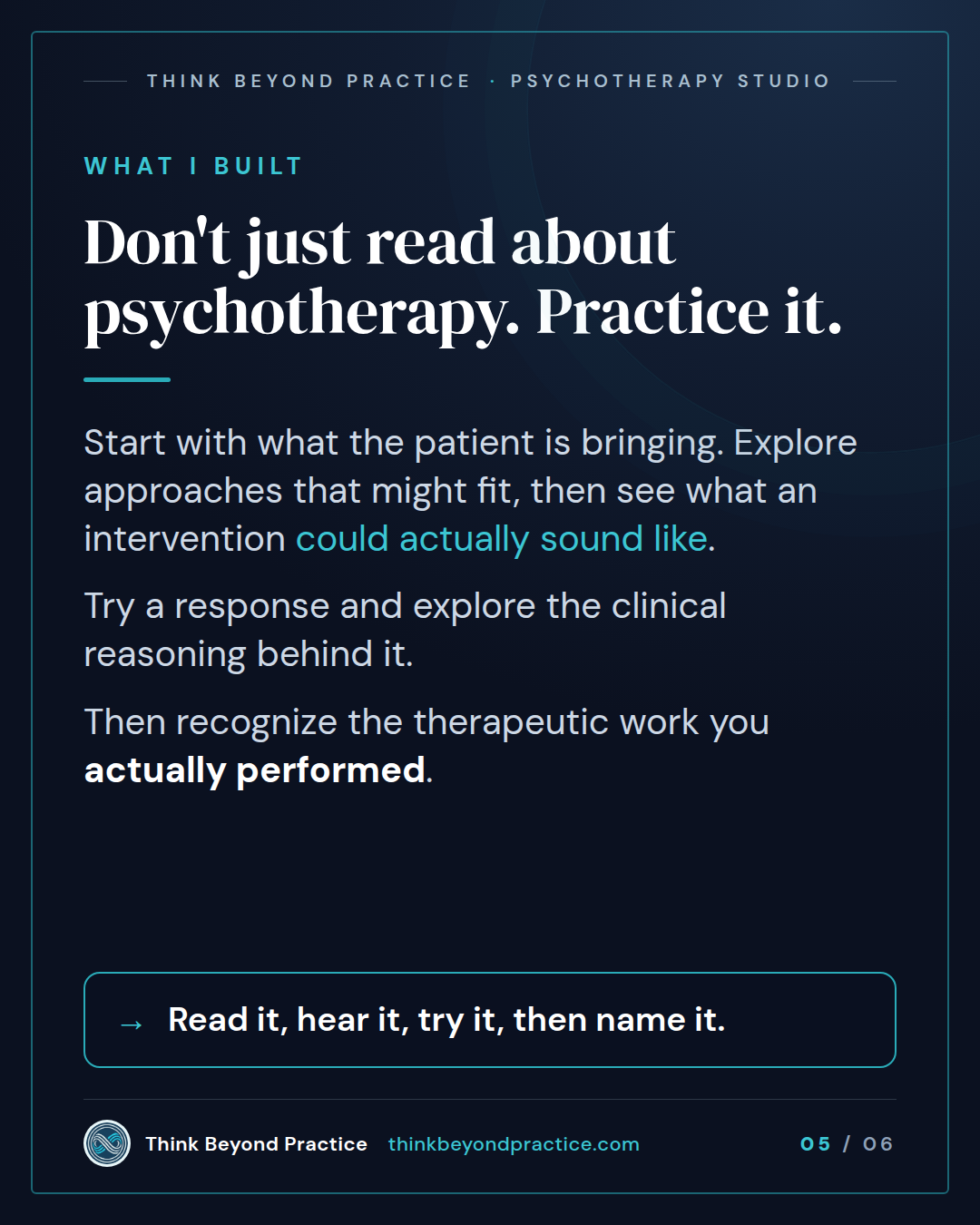
Card reading: Don't just read about psychotherapy. Practice it. Start with what the patient is bringing, explore approaches that might fit, then see what an intervention could actually sound like. Try a response and explore the clinical reasoning behind it. Then recognize the therapeutic work you actually performed.
Read it, hear it, try it, then name it.
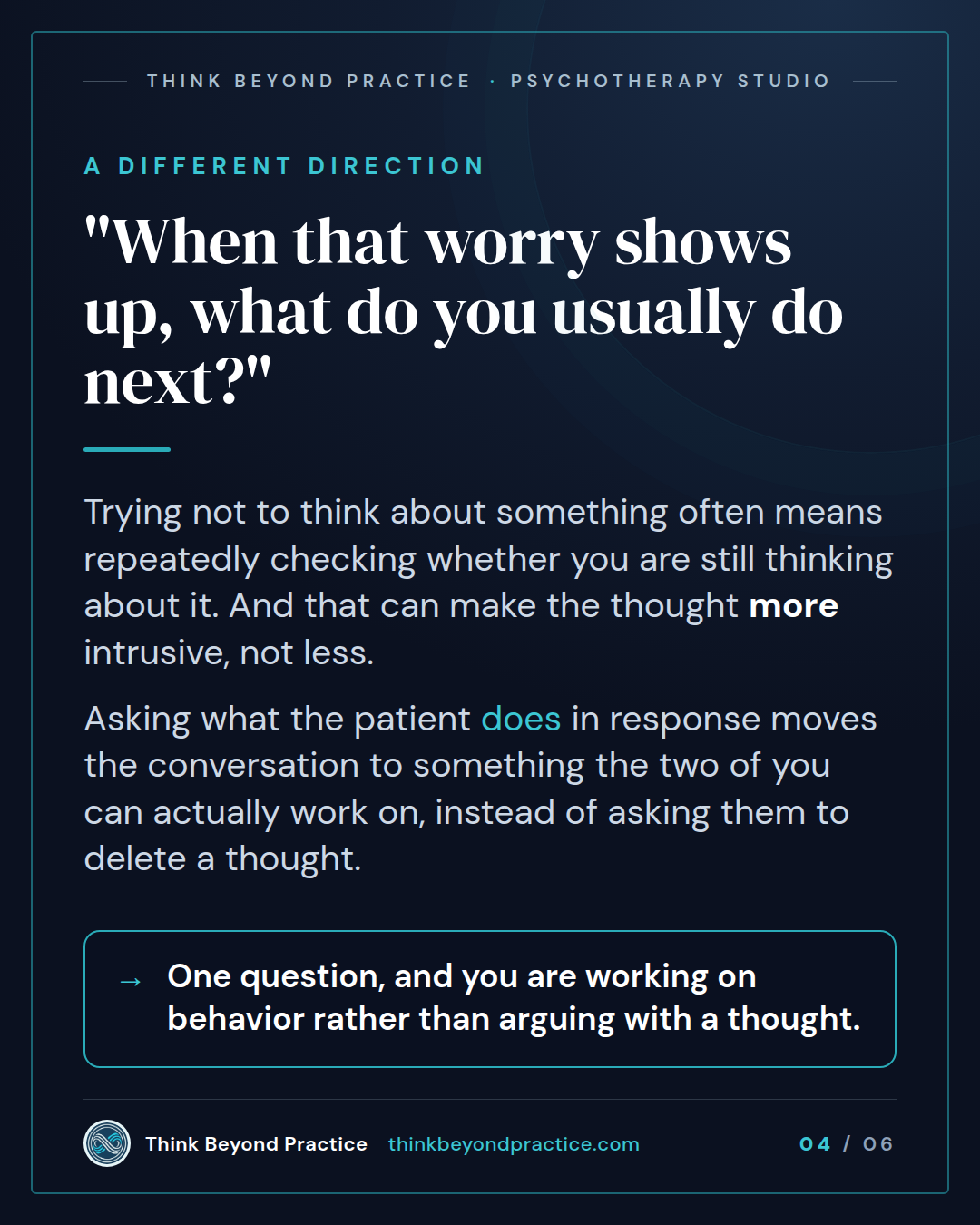
Card reading: A different direction. When that worry shows up, what do you usually do next? Trying not to think about something often means repeatedly checking whether you are still thinking about it, and that can make the thought more intrusive, not less.
Moving from the thought to what the patient does about it.

🥧 The Weekly Bite

One short, funny, clinically useful teaching moment each week, on the Studio front door. Here is the first one, in full.

Probably not your finest therapeutic moment

"Have you tried just not thinking about it?"

Deliberately pushing a thought away tends to need the thought in order to check whether it has gone, so the effort can leave it more intrusive rather than less.

Try instead: "When that worry shows up, what do you usually do next?"

That moves the conversation to what the patient actually does in response, which is something the two of you can work on, instead of asking them to delete a thought.

Live now, and what comes next.

Working today

  • All 11 modality records, clinician reviewed, with their interventions, pitfalls and documentation language.
  • Eight rooms covering preparing for a visit, recognizing what you did, documenting it, coding it, practicing, and troubleshooting.
  • One interactive practice exercise, on developing discrepancy in motivational interviewing.
  • The first Weekly Bite, on the Studio front door.
  • The Psychotherapy Documentation Phrasing Bank, also available on its own.
  • Browsing all 80 interventions directly, instead of needing to know their names.
  • Starting from a clinical focus and comparing how different approaches would work with it.
  • More practice exercises, and following a patient's response rather than stopping at one choice.
  • A growing archive of Weekly Bites, each one a way into the relevant clinical content.

Listed so you can tell what you would be joining today from what is coming. New clinical content is reviewed before it ships, which is the slow part and the point.

Psychotherapy Studio is open.

What might fit what this patient is bringing? What would that sound like in the room? What did I just do in there, and can I name it?

Built by Michael Van Gelder, PMHNP, who wanted it to exist and could not find it.